

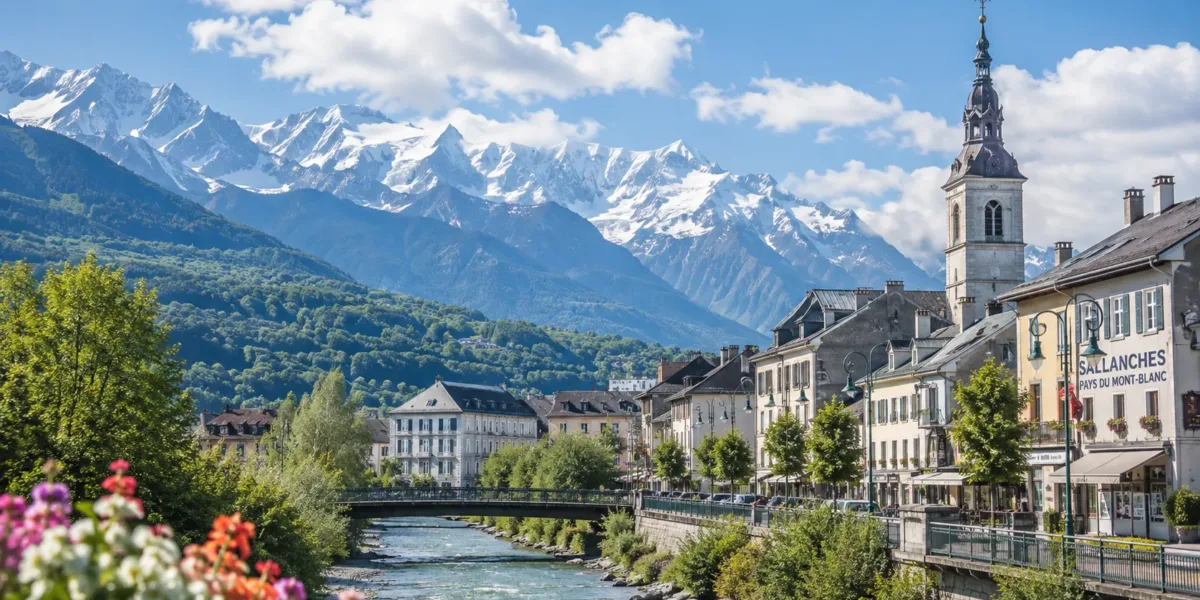
Living in the Arve valley means having Mont Blanc in front of your home, Geneva about an hour away and prices far more affordable than in the ski resorts. It is also mountain territory, with its own rules: snowy roads, mountain torrents, winters without sun in some neighbourhoods, and regulated wood heating. If you are buying your main home in Sallanches, Passy, Cluses or the neighbouring towns, here are the ten questions to ask before you sign, and where to find each answer.
Table of contents
1. Is the property exposed to a natural hazard?
Torrents in flood, rockfalls, landslides, avalanches higher up: the valley is covered by natural hazard prevention plans, which classify every plot of land. Enter the exact address of the property on Géorisques, the French government risk portal, before you even visit. The seller must then give you the risk statement (état des risques) at the first viewing; it must be less than six months old. Read it properly: it tells you whether the property is in a zone where building is allowed only under conditions, and therefore whether works or protections are required.
Source: notaires.fr, mandatory surveys for a sale. Without a valid risk statement attached to the deed, the buyer can ask for the sale to be cancelled or the price to be reduced.
2. How do you reach the property in winter?
A public road is cleared by the town; a private lane is cleared by its residents, or by the co-ownership, which bills it in the service charges. Ask which applies, who pays, and what time the snowplough comes. Look at the slope and orientation of the access: a north-facing climb stays icy for days after a snowfall. Clearing snow outside your home is not just a matter of comfort: if an accident is caused by a failure to clear it, the owner may be held liable. The simplest way is to visit, or come back, on a winter morning: that is when you understand what living in the Arve valley means in December.
3. What will heating cost, and with what appliance?
Ask for the energy performance certificate (DPE) and, if possible, the heating bills for the last two winters. Above 800 m altitude, the DPE thresholds are different: our article on energy performance certificates for a mountain home explains what changes.
Look at the wood-burning appliance too. In the 41 towns covered by the Arve valley air protection plan, using an open fireplace has been banned since 1 January 2022, including as a back-up or for pleasure. A beautiful open fireplace is therefore not a heating system. To replace an old appliance, a local grant, the Fonds Air Bois, exists: ask your community of towns (communauté de communes) about the current amount and conditions.
4. Does the home get sun in winter?
In a steep-sided valley, the mountains hide the sun for longer or shorter periods depending on the side of the valley and the altitude. Two houses a few hundred metres apart can have very different winters: one in the sun from the morning, the other in the shade for several weeks. This affects heating, how long snow stays on the access, and daily life. A summer viewing will not show it: ask the neighbours, or visit in December.
5. Living in the Arve valley: what about air quality?
Newcomers often ask about it, and it deserves a straightforward answer. In settled winter weather, cold air stays trapped at the bottom of the valley and holds fine particles; a few episodes a year trigger alerts. Old wood-burning appliances are a major source, hence the rules described above. Over the long term, air quality is improving in the region, according to the annual report of the regional observatory Atmo Auvergne-Rhône-Alpes. You can check the daily index, town by town, on the Atmo website. The hillsides and higher ground are often above this layer of cold air.
6. What will your daily commute look like?
The Léman Express (line L3) serves Sallanches-Combloux-Megève, Magland, Cluses, Bonneville and La Roche-sur-Foron through to Geneva, with no change. Allow about an hour and a half between Geneva-Cornavin and Saint-Gervais-Le Fayet, generally with one train an hour; check the timetables on the Léman Express website. By car, the A40 motorway links the valley to Geneva and Annecy, but journey times vary a lot at rush hour and on winter Saturdays. Do the real journey, at the time you will make it every day.
7. Schools, doctors, shops: does the town fit your life?
For living in the Arve valley all year round, the choice of town matters as much as the choice of property. Sallanches has most of the services of the Pays du Mont-Blanc: shops, the Saturday market, schools, healthcare. Smaller or higher villages offer more peace, but mean more driving. Before buying, ask the town hall (mairie) which school catchment the address falls into, and check the distance to the doctor, the pharmacy and the emergency department. If you work from home, test the internet connection on site: fibre is not arriving everywhere at the same pace.
8. What will you be allowed to extend or build?
An extension, a garage, a shed, a swimming pool: everything depends on the town’s local development plan (PLU) and the zoning of the plot. In the mountains, the Mountain Law (loi Montagne) also restricts building outside areas that are already built up, and the hazard prevention plan may add its own conditions. Check the PLU at the town hall and, if you have a specific project, ask for a planning certificate (certificat d’urbanisme) before signing. Our guide to buying a chalet in Haute-Savoie covers the constraints specific to timber buildings.
9. What upkeep and insurance should you plan for in the mountains?
Snow and frost have a cost: a roof and timber frame that must carry the snow, gutters, pipes to protect, perhaps a snow-clearing contract. In a co-ownership, read the minutes of the last three general meetings: they show the works voted or coming up, roofs and façades first. On insurance, check that your home insurance covers the weight of snow on the roof, under the storm, hail and snow cover, and look at the excesses.
10. What budget for which town?
Prices can double from one town to the next. On sales completed in 2024 and 2025, here are the median prices per m² in the lower valley:
| Town | Apartment (per m²) | House (per m²) |
|---|---|---|
| Passy | 3 384 € | 4 262 € |
| Sallanches | 3 694 € | 4 474 € |
| Saint-Gervais-les-Bains | 5 109 € | 7 209 € |
Source: DVF register (DGFiP), median prices per m² of sales completed in 2024 and 2025. Data consulted in October 2026.
Our town-by-town price comparison gives the detail for eight towns, and our article on buying at the bottom of the Mont-Blanc valley rather than in Chamonix shows what the same budget buys in each town.
Summary: where to find each answer
| Question | Where to check |
|---|---|
| Natural hazards | Géorisques, risk statement from the seller, hazard prevention plan at the town hall |
| Winter access | Town hall (public or private road), co-ownership rules, neighbours |
| Heating | DPE, bills, type of wood-burning appliance |
| Sunshine | Winter viewing, neighbours |
| Air quality | Daily index on the Atmo Auvergne-Rhône-Alpes website |
| Commuting | Léman Express timetables, real journey at rush hour |
| Services | Town hall (school catchment), internet connection test |
| Planning | Local development plan (PLU), planning certificate |
| Upkeep and insurance | Co-ownership minutes, home insurance policy |
| Budget | Median prices of completed sales (DVF register) |
Thinking of living in the Arve valley? For every property we offer, we gather this information before the first viewing. Discover our properties for sale in the valley, or send us your questions about a property you are interested in.
This information is general and was checked in November 2026. Local rules (planning, hazards, wood heating, grants) change: check them for each property with the town hall or the notaire.